
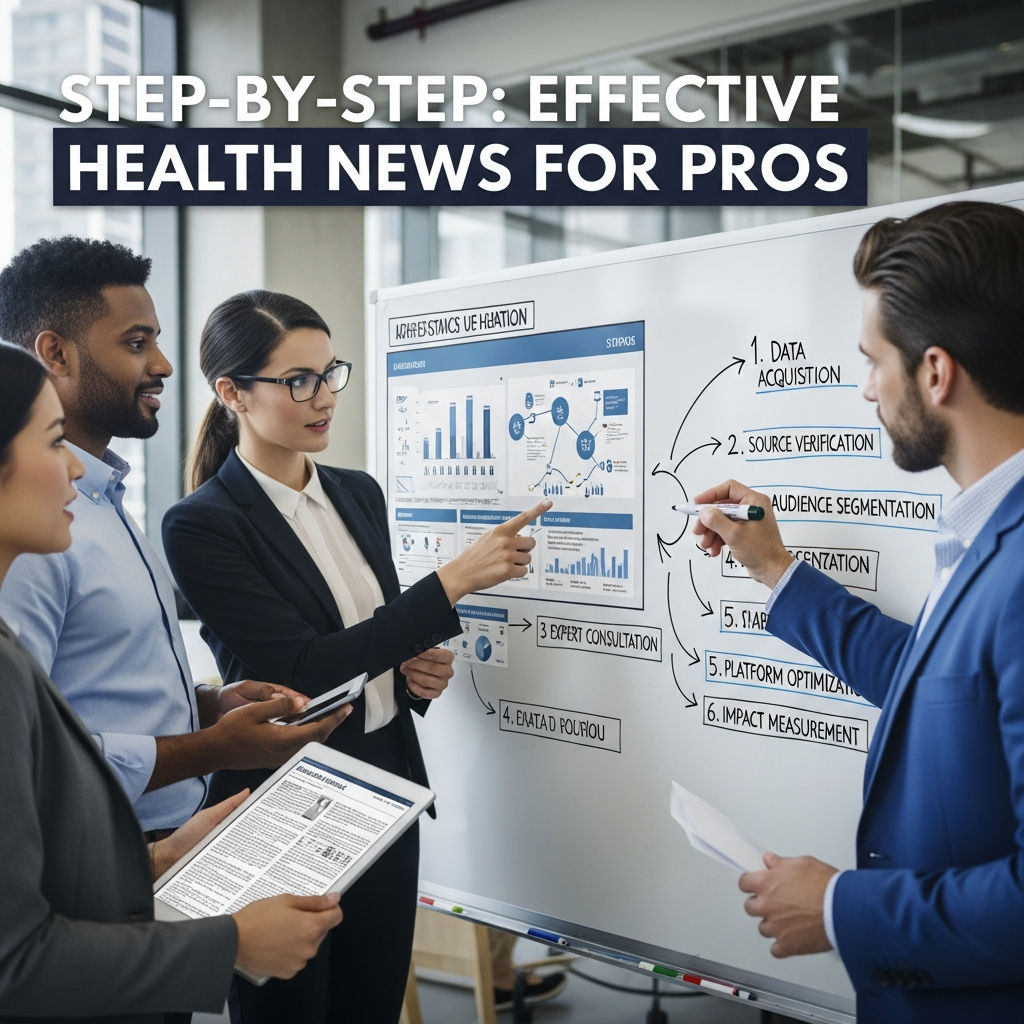
Step-by-Step: Effective Health News for Pros
In an era defined by an overwhelming “infodemic,” the ability to navigate, analyze, and communicate health news is a critical skill for healthcare professionals, medical journalists, and researchers. Health news for pros isn’t just about reading headlines; it’s about dissecting data, understanding clinical significance, and translating complex science into actionable insights. Whether you are a clinician staying updated on the latest protocols or a writer aiming for high-authority medical journalism, mastering the workflow of health news is essential.
This comprehensive guide provides a step-by-step framework for managing health news effectively, ensuring that the information you consume and share is evidence-based, timely, and impactful.
Step 1: Establishing High-Authority Sources
The foundation of effective health news for pros is the quality of the source. While mainstream media often prioritizes “viral” potential, professionals must prioritize clinical validity. To build a robust news feed, you must look beyond the press release.
- Peer-Reviewed Journals: The gold standard includes publications like The New England Journal of Medicine (NEJM), The Lancet, JAMA, and Nature Medicine. These provide the raw data before it is filtered by secondary outlets.
- Preprint Servers: For the most cutting-edge (though not yet peer-reviewed) data, pros monitor medRxiv and bioRxiv. Use these with caution, as the findings are preliminary.
- Regulatory Agencies: Follow updates from the FDA, EMA, and CDC for official rulings on drug approvals, safety alerts, and public health guidelines.
- Medical Aggregators: Platforms like Medscape, Stat News, and CIDRAP offer curated news specifically tailored for a professional audience, often providing expert commentary alongside study summaries.
Step 2: Critically Appraising the Study Design
Not all health news is created equal. A “breakthrough” in a mouse model is vastly different from a Phase III human clinical trial. As a professional, your second step is to look at the methodology behind the news.
Understanding the Hierarchy of Evidence
When reviewing a new study, categorize it based on its design. Systematic reviews and meta-analyses sit at the top of the hierarchy, followed by randomized controlled trials (RCTs). Observational studies, case reports, and animal studies provide lower levels of certainty and should be reported with appropriate caveats.
Sample Size and Duration
A study involving 20 participants may show a trend, but it rarely justifies a change in clinical practice. Effective health news analysis requires looking at the “N” (number of participants) and the duration of the study. Does the study follow patients long enough to see long-term side effects or sustained efficacy?
Step 3: Distinguishing Between Statistical and Clinical Significance
One of the most common pitfalls in health reporting is conflating statistical significance with clinical relevance. A drug might lower blood pressure by a statistically significant 2mmHg (p < 0.05), but if that change doesn’t result in fewer heart attacks or strokes, it may not be clinically meaningful for the patient.
Pros should look for the Number Needed to Treat (NNT). This metric tells you how many people need to receive an intervention for one person to experience the intended benefit. A low NNT suggests a highly effective intervention, while a high NNT may suggest that the “breakthrough” is less impactful than the headlines suggest.
Step 4: Analyzing Relative vs. Absolute Risk
Health news often uses “relative risk” to make findings sound more dramatic. For example, a headline might claim that a specific food “doubles the risk of cancer.” While technically true, if the absolute risk increases from 1 in 1,000,000 to 2 in 1,000,000, the actual danger to the public is negligible.
- Relative Risk: Expressed as a percentage (e.g., “50% increase”).
- Absolute Risk: Expressed as the actual difference in probability (e.g., “An increase of 0.0001%”).
Effective health news for pros always contextualizes these numbers to prevent unnecessary alarm and provide a realistic outlook on public health threats or benefits.
Step 5: Curating and Organizing Information
Pros cannot spend all day browsing journals. To be effective, you must automate your intake. Curation tools allow you to filter the noise and focus on your specific area of expertise.

Using RSS Feeds and Alerts
Set up PubMed alerts for specific keywords related to your field. Use RSS aggregators like Feedly to pull headlines from multiple medical journals into a single dashboard. This allows you to scan hundreds of headlines in minutes, diving deep only when a study meets your criteria for significance.
Leveraging Social Media Professionally
“Medical Twitter” (or MedX) and LinkedIn are powerful tools for real-time peer review. Following key opinion leaders (KOLs) allows you to see how experts in the field are interpreting new data. However, always verify their insights against the original source material.
Step 6: Communicating Health News with Integrity
If your role involves sharing health news—whether through a newsletter, a patient consultation, or a medical blog—how you present the information is as important as the information itself. Effective communication requires clarity, context, and caution.
Avoid “Cure” and “Miracle” Language
Professional health news avoids sensationalist adjectives. Use precise language like “associated with,” “correlated,” or “suggests a potential benefit.” This maintains your credibility and manages the expectations of your audience.
Translating Jargon for the Target Audience
If you are communicating with other pros, technical shorthand is efficient. If you are translating news for patients or the general public, you must simplify the language without losing the scientific nuance. This is known as “health literacy” advocacy.
Disclosing Conflicts of Interest
Always check the “Conflicts of Interest” or “Funding” section of a study. If a study touted as health news was funded by a company with a financial stake in the outcome, this context must be included in your reporting or analysis.
Step 7: Identifying Trends and Synthesizing Data
Effective health news for pros isn’t just about individual stories; it’s about connecting the dots. One study is a data point; three studies are a trend. Professionals look for “signal” within the “noise.”
By synthesizing information from various sources—such as a new drug trial, a regulatory update, and a shift in clinical guidelines—you can provide a holistic view of where a particular field of medicine is heading. This high-level synthesis is what separates a news “aggregator” from a true “health news professional.”
Conclusion: The Value of Precision in Health News
Mastering health news for pros is a continuous process of learning and unlearning. In a world where misinformation spreads faster than clinical data, the role of the professional is to act as a bridge between complex science and practical application. By following this step-by-step approach—sourcing high-quality data, analyzing methodology, and communicating with transparency—you ensure that your contribution to the health ecosystem is both accurate and invaluable.
Stay curious, remain skeptical of “easy” answers, and always return to the evidence. This is the hallmark of effective health news reporting and consumption in the professional sphere.